

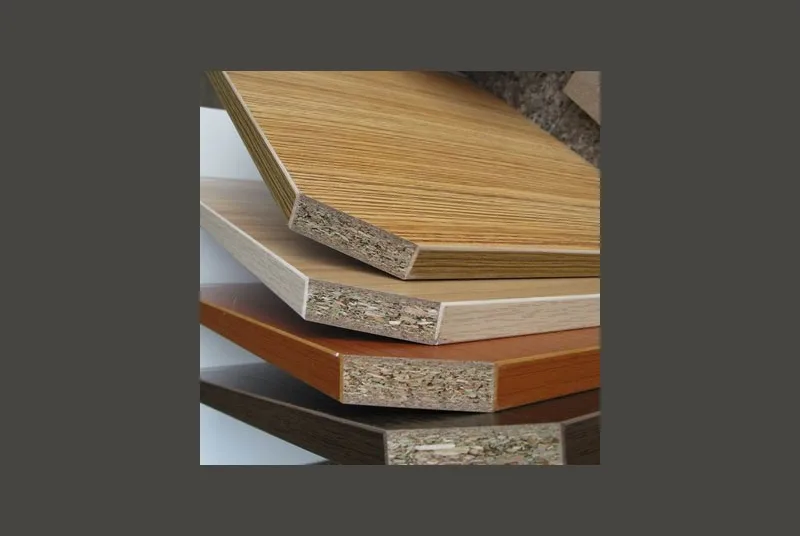
The main raw materials used in furniture manufacturing are melamine-coated particleboard, MDF panels (solid and veneered), and aluminum profiles. Each of these materials has its own unique properties and characteristics. Together, they offer a wide variety of options and allow for the implementation of diverse design solutions and styles—from classic to modern. We will try to clarify their main characteristics and the differences between them.
Particleboard (wood particle boards). As the name suggests, they consist of coarse wood particles pressed between two face layers. The popularity of particleboard is mainly due to the fact that its decorative finish successfully mimics various colors and wood grain patterns. Furthermore, this type of material offers excellent value for money, making it an excellent choice when you need a great balance of price and quality. One drawback is that the manufacturing process for particleboard components involves cutting them to size and applying edge banding to the cut surfaces using special PVC or melamine edging. It is precisely these edge-banded areas that are the most vulnerable, as over time there is a risk of the banding peeling off and moisture absorption. Therefore, they require extra care and proper maintenance.
Natural MDF (Medium Density Fiberboard) is a slightly more specialized material than particleboard. It translates to “medium-density fiberboard.” These panels are produced from softwood using a dry-pressing method under high pressure and temperature, which results in a finer and more homogeneous structure of the material. This type of material has recently become an important component in furniture manufacturing. This is primarily due to MDF’s good workability and the possibility of additional finishing treatments. Unlike particleboard, MDF allows for three-dimensional shaping and can be routed into various patterns and shapes. These qualities are perfectly complemented by modern technologies for applying paint and lacquer coatings to components or natural veneers. In terms of its properties, MDF is characterized by a smooth surface and high strength. In addition, it possesses high elasticity and bending strength.
HDF (High-Density Fiberboard). The raw material for both MDF and HDF is wood fiber, consisting of soft and hard wood particles mixed with wax and adhesive and pressed at high temperature. The first difference between MDF and HDF is that, for HDF panels, the pressing temperature and pressure are much higher, which gives the material greater strength. Because of this, it is possible to manufacture them in thin thicknesses of 3–4 mm. They are mainly used for making furniture backs and drawer bottoms.
www.garderobi.bg’s system uses specific customer-friendly names for the materials.
We will try to explain here what each term means.
Laminate
These are melamine-coated particleboard panels with solid-color and wood-grain finishes.
Gloss Laminate
These are melamine-coated particleboard panels with solid-color and wood-grain finishes.
They are finished with a colorless polyurethane varnish—100% gloss.
Pastel UV
These are MDF panels that are painted on both sides with a highly durable UV coating in RAL color 9010.
The edges of the panels are milled to R 3, R 6, R 9, or R 16.
Pastel
These are MDF panels with a water-based acrylic coating. Edge finishing is done to R 3, R 6, R 9, or R 16.
The process begins by applying a neutral, highly durable UV coating to both sides. In the next step, the front surface of the panel is painted with tinted paint in the desired color. The surface finish remains MATTE.
Pastel Glaze
These are MDF panels with a water-based acrylic coating. Edge finishing with R 3, R 6, R 9, or R 16
The panels are first sealed on both sides with a neutral, highly durable UV coating. In the next step, the front surface of the panel is painted with tinted paint in the corresponding color. The front surface is then finished with a clear polyurethane varnish—100% gloss.
We hope this information will help you make the best decision when selecting materials for your furniture. If you still have any questions, please don’t hesitate to contact us.